
Morningside Music Bridge – groundbreaking barrier-free summer program for exceptional young musicians – celebrates 30th anniversary season
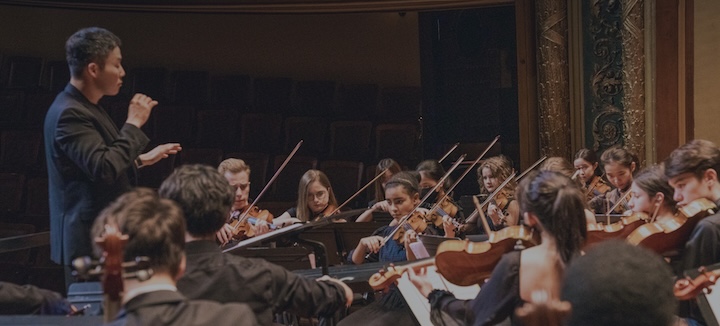
Earl Lee conducts the Morningside Music Bridge Orchestra (photo: courtesy of MMB)
(March 2026) — Morningside Music Bridge (MMB) – the groundbreaking international summer program that launched the careers of Yuja Wang and other classical luminaries – celebrates its 30th anniversary this season. Since its founding in Calgary, Canada, in 1997, the program has brought together more than 1,000 of the world’s most promising young violinists, violists, cellists, pianists, and creative artists, aged 12 to 18, for an intensive and fully-funded month of training and performance with faculty drawn from the ranks of leading solo and chamber performers, orchestras, and educational institutions worldwide. Now making its permanent home in Boston, in partnership with the New England Conservatory, MMB continues to foster extraordinary talent, global collaboration, and barrier-free music making, and now marks three decades of transformative impact on the classical music world.
The Morningside Music Bridge story
Morningside Music Bridge was born from a shared belief in young talent and a willingness to build something new without a blueprint. Its origins date from 1996, when future Founder and Executive Director Paul Dornian, then Director of Calgary’s Mount Royal University Conservatory, met Andy Chan, future Board Chair of the Morningside Music Bridge Foundation. After visiting China’s Shanghai Conservatory together, they invited two young musicians back to Canada for a summer of study and performance.
Those students’ experience inspired the program Chan and Dornian would formally launch in July 1997, establishing what was soon to become a new benchmark for international summer music programs. With MMB, they set out to address a significant gap in music education: the lack of high-level opportunities for exceptionally gifted musicians between the ages of 12 and 18: the stage when coaching, mentorship, performance, and peer influence can be most transformative. Dornian explains:
“When we started, there were countless programs for older students, but almost nothing at this level for younger ones. This is the age when you can have the greatest impact. By the time students reach university, it’s much harder to make a difference.”
From the outset, MMB was founded on the radical and defining principle of barrier‑free access. Fully scholarship‑based since the start, the program covers all tuition, travel, and room and board costs, allowing admission to be determined solely on artistic merit. Dornian says:
“It was always essential that the program be barrier‑free: talent based, not means based. If a young musician belongs here artistically, finances should never stand in the way. Talent is universal – opportunities are not – so we strive to bridge that gap.”
Participants were initially selected by live audition, at first only in Canada and China, then also, through a formal partnership with the Polish Ministry of Culture, in Poland too. Thanks to close faculty ties with leading U.S. conservatories, auditions were subsequently opened to students from the United States, now the program’s largest single source of participants. Soon strong applicant pipelines were developed in Japan, South Korea, and Israel as well. The transition to video auditions enabled MMB to become truly global, and today the program attracts applications from more than 30 countries on five continents each year. This international mix remains central to MMB’s identity, reinforcing its founding belief that young musicians learn not only from great teachers, but from one another – across borders, cultures, and musical traditions. Nevertheless, Dornian and Chan remain determined to keep the program small and personal, maintaining an intimate environment where mentorship and peer relationships can thrive. Dornian says:
“One of the most powerful elements of the program is what happens when you put extraordinary young people together. They push each other, inspire each other, and start believing what’s possible simply by seeing what their peers can do.”
Morningside Music Bridge today
Today’s MMB represents the fulfilment of the pair’s original vision. Each summer, 65–68 students participate in a month of intensive training and performance. Most are violinists, violists, cellists, or pianists, all of whom receive multiple private lessons and masterclasses each week, as well as three weeks of chamber music coaching and rehearsal. String players then devote their final week to orchestral music, while pianists conclude with a weeklong focus on four-hands repertoire. In recent years, MMB has also offered one or two summer scholarships to young composers, filmmakers, and other creative artists, each of whom follows a specially tailored program, created in collaboration with partner organizations in the Boston area. Over the course of the program, students attend concerts by faculty members and special guest artists, as well as taking part in more than 20 free public performances themselves. Since 2023, the Morningside Music Bridge on Tour initiative has expanded the program’s international reach, presenting students and alumni to audiences in the U.S., UK, and Poland.
Distinguished faculty
Morningside Music Bridge routinely ignites mentorships spanning decades and continents. Selected by Dornian in collaboration with the program’s Advisory Council, faculty members are drawn from among the world’s most respected teachers and performing artists. Today’s distinguished members represent orchestras including the Berlin Philharmonic, New York Philharmonic, and Chicago Symphony Orchestra, and higher educational institutions including North America’s Juilliard School, Curtis Institute of Music, San Francisco Conservatory, Oberlin Conservatory, Columbia University, Northwestern University, and CUNY Graduate Center; Europe’s Royal Academy of Music, Fryderyk Chopin University of Music, and Universität Mozarteum Salzburg; and Asia’s Shanghai Conservatory and Central Conservatory of Music, Beijing.
Yuja Wang and other notable alumni
Morningside Music Bridge boasts a world-class roster of alumni. Those who have attended the program include Diyang Mei, First Principal Violist of the Berlin Philharmonic; Canadian violinist Nikki Chooi, former Concertmaster of New York’s Metropolitan Opera Orchestra; his brother, violinist Timothy Chooi, a top prize winner at both the 2019 Queen Elisabeth and 2018 Joachim International Violin Competitions; Canadian pianist Jaeden Izik-Dzurko, First Prize winner at the 2024 Leeds International Piano Competition; Korean-Canadian conductor Earl Lee, former Assistant Conductor of the Boston Symphony Orchestra; Chinese-Canadian violist Teng Li, Principal Violist of the Chicago Symphony Orchestra; Canadian pianist Jan Lisiecki, youngest recipient of Gramophone’s Young Artist Award; Polish pianist Szymon Nehring, First Prize winner at the Arthur Rubinstein International Piano Competition; American pianist Clayton Stephenson, winner of the 2025 Sphinx Medal of Excellence and 2022 Gilmore Young Artist Award; Chinese violinist Angelo Xiang Yu, winner of the 2010 Yehudi Menuhin International Violin Competition and a member of the Shanghai Quartet; and Chinese-American pianist Yuja Wang, winner of the 2023 Grammy Award for Best Classical Instrumental Solo, and one of classical music’s brightest stars.
Lifelong alumni connections
Over the past three decades, the program has sparked many lifelong connections. Violinist Shanshan Yao was one of the two first students to travel from Shanghai to Calgary under Dornian’s auspices. After further studies at Curtis and Juilliard, she joined the Pittsburgh Symphony where she first met her future husband, violinist Noah Bendix‑Balgley – now first concertmaster of the Berlin Philharmonic and a core MMB faculty member. Despite going on to build careers on opposite sides of the Atlantic, at the New York and Berlin Philharmonics respectively, the two soon found themselves inviting MMB friends and faculty to their wedding, where Dornian spoke at the ceremony. They are now both members of the MMB Advisory Council as well as of the noted Rosamunde String Quartet, of which all four artists are MMB alumni or faculty. It was at MMB that violinist Ning Feng first met his wife, cellist Ying Guo, and similar stories abound throughout the alumni network. Numerous alumni now return to the program as faculty members, mentors, guest artists, and conductors, creating a multigenerational artistic community in which support and friendship endure well beyond the summer. Dornian reflects:
“We see alumni helping each other years later – recommending one another, inviting each other to perform, and teaching the next generation. Those relationships begin when they’re teenagers and often last a lifetime.”
Sponsorship
The fully-funded program is operated administratively through the Morningside Music Bridge Foundation, a Canadian nonprofit, with generous support from the Chan family and other donors. Further details are provided here.