
Orchestra of St. Luke’s winter/spring 2026: three Carnegie mainstage concerts, including return of Louis Langrée for America at 250 (March 26); Five Boroughs Music Festival celebrates friendship between Harry T. Burleigh and Dvořák (May 7–18); OSL Bach Festival in Carnegie’s Zankel Hall (June 2–23); & more
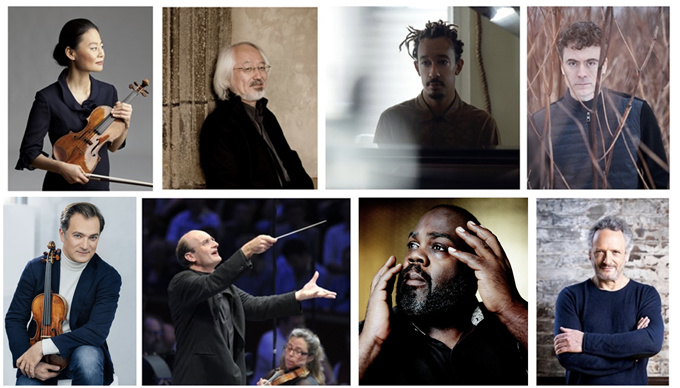
Row one: Midori (photo: Timothy Greenfield-Sanders), Masaaki Suzuki (photo: Marco Borggreve), Gerald Clayton (photo: Ogata), Paul Lewis (photo: Kaupo Kikkas); Row two: Renaud Capuçon (photo: Benjamin Decoin), Andrew Manze (photo: Chris Christodoulou), Reginald Mobley (photo: Richard Dumas), Louis Langrée (photo: Chris Lee)
(January 2026) — Orchestra of St. Luke’s (OSL) continues to offer “a range of experiences unequaled in the city” (The New York Times) this season. Building on the momentum achieved during its 50th anniversary in 2024–25, which included 78 concerts over 42 weeks and more than $15 million in gifts, OSL is in the midst of its largest season to date. On the heels of its performance of Rodgers & Hammerstein’s classic musical Oklahoma! on Carnegie Hall’s mainstage, opening the venue’s “United in Sound: America at 250” festival, Andrew Manze makes his Stern Auditorium / Perelman Stage debut, leading pianist Paul Lewis – also making his debut in the main hall – in Beethoven’s Piano Concerto No. 4, along with Haydn’s “Palindrome” Symphony and John Adams’s Fearful Symmetries, a 1988 OSL commission (Feb 12). Next, Louis Langrée, returning for the second season in a row with OSL after an acclaimed debut, conducts the Carnegie Hall debut of jazz pianist Gerald Clayton, in a program of Ives, Ellington, Gershwin, and Bernstein as part of the “United in Sound: America at 250” festival (March 26). Finally, conductor Masaaki Suzuki leads violinist Midori in Beethoven’s Violin Concerto in D, on a program with music of Mozart and Mendelssohn (April 30). The annual OSL Bach Festival in Carnegie’s Zankel Hall comprises five performances, respectively featuring: conductor Paul McCreesh and countertenor Reginald Mobley (June 2); cellist Pieter Wispelwey (June 10), who also gives a special added performance of Bach’s complete Cello Suites (June 7); French violinist Renaud Capuçon (June 16); and French harpsichordist Jean Rondeau (June 23). Meanwhile, OSL’s Chamber Music Series in Carnegie’s Weill Recital Hall features a new OSL-commissioned clarinet quintet by Jonathan Tunick, on a program also featuring baritone John Brancy in music of Barber and Sondheim (Feb 25); and a program of quintets by Dvořák and Amy Beach featuring guest pianist Orli Shaham (May 13).
Beyond Carnegie Hall, OSL is presented by the Five Boroughs Music Festival in performances celebrating the friendship between pioneering Black American composer Harry T. Burleigh and Antonín Dvořák (May 7–18); and two performances remain this season in the “Visionary Sounds” series, which highlights groundbreaking 20th- and 21st-century chamber music at The DiMenna Center for Classical Music: iconoclastic composer Julius Eastman’s Femenine (Feb 4); and a program devoted to the music of pioneering, Brooklyn-based Syrian clarinetist Kinan Azmeh (April 15). Finally, looking ahead to summer 2026, composers from OSL’s DeGaetano Composition Institute will present world premiere compositions for chamber orchestra on July 28.
OSL at Carnegie Hall
OSL is in the midst of a Carnegie Hall season of 14 concerts: five on the Stern Auditorium / Perelman Stage, five in Zankel Hall, and four in Weill Recital Hall. Earlier this month, OSL opened Carnegie Hall’s “United in Sound: America at 250” festival with a concert version of Rodgers & Hammerstein’s groundbreaking musical Oklahoma! The birthday celebrations continue when conductor Louis Langrée – following a 2024–25 performance with OSL that marked his long-awaited Carnegie Hall debut – returns to lead the orchestra in a program of American music by Ives, Ellington, Gershwin, and Bernstein that features jazz pianist, composer, and six-time Grammy nominee Gerald Clayton making his Carnegie Hall debut as soloist. Langrée has just completed a “transformative” (The New York Times) decade as Music Director of the Cincinnati Symphony, and has long been beloved by New York City audiences for his artistic leadership as Music Director of the Mostly Mozart Festival from 2003 to 2023. This tenure was, as The New York Times declared, “by any measure a triumph of ensemble-building and musical curiosity,” capping a “quietly remarkable” career that has been “a steady climb of prestige and quality” (March 26).
Another U.S. composer is featured when conductor Andrew Manze, the distinguished early music violinist who formerly served as both Artistic Director of The English Concert and Principal Conductor of the NDR Radiophilharmonie, makes his Stern Auditorium / Perelman Stage debut leading OSL in a program juxtaposing Haydn and Beethoven with John Adams’s Fearful Symmetries, which OSL commissioned and premiered in 1988. In Adams’s description, the timbre of the work “mixes the weight and bravura of a big band with the glittering, synthetic sheen of techno pop (samples and synthesizer) and the facility and finesse of a symphony orchestra.” Adams also says of the work that, as the title suggests, it is “maddeningly symmetrical,” making it a natural complement to one of Haydn’s experiments in symmetry, his Symphony No. 47, “Palindrome,” in which the second half of the minuet is an exact reversal of the theme of the first half. The program is rounded out by Beethoven’s Fourth Piano Concerto with Paul Lewis – also making his Stern Auditorium / Perelman Stage debut – as soloist. Reviewing Lewis’s complete Beethoven sonata recordings in The New York Times, Anthony Tommasini commented: “If I had to recommend a single complete set, I would suggest Mr. Lewis’s distinguished recordings” (Feb 12).
For its final Carnegie mainstage performance of the season, OSL is led by Masaaki Suzuki, the founder and music director of the Bach Collegium Japan. He is joined by Midori for a performance of Beethoven’s sole Violin Concerto, which languished for almost four decades after an unsuccessful first performance before being resurrected by then-12-year-old violinist Joseph Joachim. Opening the program is Mozart’s Overture to Don Giovanni, and Suzuki also conducts the orchestra in a performance of Mendelssohn’s Fourth “Italian” Symphony. Mendelssohn, it so happens, was also the conductor of the Royal Philharmonic Society performance in 1844 in which Joseph Joachim finally gave Beethoven’s belatedly recognized masterpiece Violin Concerto its due (April 30).
OSL Bach Festival presented in association with Carnegie Hall (June 2–23)
The 2026 edition of the OSL Bach Festival – on the heels of the completely sold-out 2025 festival – examines the ways in which Bach was a predecessor of the early Classical period, not only exemplified by the music of his own sons but by early Mozart and Haydn. For the first performance, countertenor Reginald Mobley returns for the second year in a row, this time under the baton of conductor Paul McCreesh, Artistic Director of the Gabrieli Consort & Players, an organization he founded in 1982. Repertoire for the concert includes Mozart’s Symphony No. 25 in G minor, the sinfonia from Bach’s Cantata No. 42, and “Vergnügte Ruh, beliebte Seelenlust” (BWV 170), his cantata for countertenor (June 2).
In a special, added performance, Dutch cellist Pieter Wispelwey will perform the complete Bach Cello Suites in Zankel Hall. The cellist has released three recordings of the suites over the course of his career, most recently on the Evil Penguin label in 2017, about which Strings magazine declared: “His Bach is studded with touching moments of vulnerability that differentiate each suite, each movement, each bar, in the composer’s vast kaleidoscope universe” (June 7). Wispelwey is featured again in the next Bach Festival performance, playing Haydn’s Cello Concerto No. 1 in C. Reviewing his Channel Classics box set released earlier this year, Gramophone called him “a daring interpreter with thought-provoking ideas,” adding: “The ease with which Wispelwey moves between period and modern practice is a marvel and an excellent reason to root around in this box” (June 10).
French superstar violinist Renaud Capuçon plays and directs the fourth Bach Festival program, which centers on Bach’s A minor Concerto for Violin and Mozart’s Symphony No. 29. Also on the program is a pairing of Mozart’s Adagio in E major and Rondo in C, which were both composed at the request of Italian violinist Antonio Brunetti, and Bach’s Overture from the Orchestral Suite No. 2. The Artistic Director of the Orchestre de Chambre de Lausanne, Capuçon recently released a recording of Mozart violin concertos with the orchestra that included the Adagio in E and Rondo in C. The Classic Review commented that “Capuçon plays beautifully, as one would expect; his tone is warm and inviting. Articulation is spotless, with plenty of rhythmic energy” (June 16).
The Bach Festival’s final performance features French harpsichordist Jean Rondeau leading from the keyboard. The program includes two Concertos in D minor, by both J.S. Bach and his son Carl Philipp Emanuel, Johann Christian Bach’s Concerto in F minor, and Rondeau’s own transcription of C.P.E. Bach’s Andante con tenerezza from Sonata in A major. The Washington Post calls Rondeau “one of the most natural performers one is likely to hear on a classical music stage these days. Affectation and ostentation are not part of his makeup and, once seated at the instrument, he and the harpsichord become one” (June 23).
OSL presents Chamber Music Series
Two more performances remain in the current season of OSL’s Chamber Music Series, performed in Carnegie’s Weill Recital Hall. The world premiere of an OSL-commissioned clarinet quintet by Jonathan Tunick highlights the first of these. Baritone John Brancy also joins the program, singing Samuel Barber’s Dover Beach and selected songs by Stephen Sondheim, with the program rounded out by two other Barber works: the Serenade for Strings and the String Quartet in B minor (Feb 25).
Wrapping up the season, the Chamber Music Series welcomes pianist Orli Shaham as guest artist for two milestones of the chamber music repertoire: Amy Beach’s Piano Quintet in F-sharp minor and Dvořák’s Piano Quintet in A major. Beach’s work is relatively subdued but with a bottled-up emotional intensity for the first two movements, before a climactic unleashing of energy in the finale. The composer’s biographer, Adrienne Fried Block, noted that the Boston critics, “in an instance of unanimity, greeted the work as an important contribution to the literature.” Dvořák’s Piano Quintet is likewise acknowledged as a masterpiece of the form and one of the most significant pieces of late Romantic chamber music (May 13).
50th anniversary recap, renewal and expansion
Zachary Woolfe’s “Critic’s Notebook,” published in The New York Times last January, profiled OSL in its 50th anniversary year, painting a dynamic picture of a thriving organization “willing to seize the moment.” The article was published a week after Raphaël Pichon’s debut performance with OSL, which Woolfe called “one of the most interesting and satisfying concerts of the classical music season … cast[ing] a rare spell.” Pichon returned in the current season for a fall performance, and the orchestra continues to build its artistic relationship with Louis Langrée, as well as growing relationships with Andrew Manze, Masaaki Suzuki, and this season’s other guest conductors.
Along with its ability to attract celebrated guest conductors, another measure of OSL’s organizational health is the $10 million raised from 12 donors during the orchestra’s 2024–25 anniversary season, comprising $4 million in cash and $6 million in planned gifts through The Marianne Lockwood Society, a bequest program that allows donors to express their long-term support of OSL in their estate planning. As Woolfe’s article also pointed out, with the cash gifts taken into account, OSL’s endowment has roughly quadrupled since 2015, when James Roe took over as President and Executive Director. Emme Deland, the Chair of OSL’s Board of Directors, comments:
“Orchestra of St. Luke’s has been one of the most vital artistic forces in New York City for the past 50 years. These gifts represent a powerful and generous expression of confidence in our next 50!”
In the end, an orchestra’s vitality is most visibly expressed through its players and their performances, and OSL’s roster continues to expand with the next generation of outstanding creative artists. The orchestra added a remarkable eleven players to the tenured roster in 2024–25, with one more added in the current season.
Following the departure of beloved Principal Conductor Bernard Labadie after a seven-year tenure, OSL will continue to work with a roster of internationally acclaimed guest conductors, growing relationships and building new ones, as it considers the shape of its next musical leadership.
Five Boroughs Music Festival
This season, OSL is presented by the Five Boroughs Music Festival in a program celebrating the friendship and collaboration between Antonín Dvořák, who led the nascent National Conservatory of Music, and Harry T. Burleigh, who was a student. It was from Burleigh that Dvořák learned some of the plantation songs that found their way into the New World Symphony, and Burleigh later became Dvořák’s personal assistant. The Five Boroughs Music Festival will feature the St. Luke’s Chamber Ensemble along with baritone Joseph Parrish, performing selected songs by Burleigh and his Southland Sketches for violin and piano, alongside Dvořák’s Sonatina in G for violin and piano (May 7–18).
“Visionary Sounds” at DiMenna Center
The two Visionary Sounds concerts this winter and spring are reprises of programs that were first heard livestreamed during the pandemic in OSL’s interdisciplinary “Sounds & Stories” concert series, which explored music as a medium for storytelling. OSL was praised at the time as having “responded robustly and creatively to the constraints of streamed performance” (The New York Times), leading the New York City field in terms of innovation, frequency and production values. This season’s Visionary Sounds first revisits Femenine, an improvisatory tour de force by the late Julius Eastman, who strove to be “Black to the fullest, a musician to the fullest, [and] a homosexual to the fullest,” and whose take on minimalism was “idiosyncratic and perhaps ahead of its time” (The New York Times) (Feb 4).
Closing out the Visionary Sounds series is a program of music by composer-clarinetist Kinan Azmeh, a member of Yo-Yo Ma’s Silkroad Ensemble since 2012 and featured clarinetist and composer on their Grammy-winning 2017 album, Sing Me Home. Azmeh collaborated with OSL on two projects in 2022: he performed a virtual concert titled “Far From Home” and was the guest artist for that season’s OSL School Concert, a six-part series of interactive performances designed for K-12 students to explore his music and creative process. This season, Azmeh joins OSL in person for live performances of his music, when Visionary Sounds features two of his chamber works exploring the concept of “home” through locations of personal significance to the composer. Café Damas – for violin, cello, and double bass – evokes a coffee shop in his hometown of Damascus in the 1950s, while In The Element for clarinet and string quartet conjures the Apple Hill Center for Chamber Music in New Hampshire, where Azmeh spent time as a teenager and to which he has returned regularly over the course of three decades (April 15).
About Orchestra of St. Luke’s
Orchestra of St. Luke’s (OSL) features New York City’s most talented concert musicians and makes its artistic home at Carnegie Hall, where it has performed more than any other orchestra since its debut there in 1983. OSL’s annual season features concert series in each of Carnegie Hall’s three venues, along with the Visionary Sounds and DeGaetano Composition Institute programs focused on contemporary composers at The DiMenna Center for Classical Music, the rehearsal, recording, and performance facility OSL built in 2011 and continues to operate in Manhattan’s Hudson Yards neighborhood. OSL proudly collaborates with Paul Taylor Dance Company for their Lincoln Center season each year and performs with a variety of artistic partners at venues throughout the city and beyond. Founded in 1974 when a group of virtuoso chamber musicians began performing together in Greenwich Village at The Church of St. Luke in the Fields, the ensemble later expanded into an orchestra before catching fire on New York’s classical music scene. OSL has participated in 120 recordings, four of which have won Grammy Awards, has commissioned more than 75 new works, and has given more than 200 world, U.S., and New York City premieres. OSL champions composers from historically underrepresented groups in classical music. In recent seasons, it has presented works by Kinan Azmeh, Margaret Bonds, Valerie Coleman, Julius Eastman, Wynton Marsalis, Florence Price, Rita Dove, and Chen Yi, among others. Central to OSL’s mission, the Education and Community Engagement program presents free concerts for thousands of New York City public school students each year; offers the 120-student strong Youth Orchestra of St. Luke’s (YOSL), the city’s only youth orchestra under the umbrella of a professional group; provides a mentorship program for pre-professional musicians; and brings accessible concerts to all five boroughs. To learn more, visit OSLmusic.org or follow @OSLmusic on YouTube, Spotify, Instagram, Facebook, or TikTok.
Orchestra of St. Luke’s: winter/spring 2026 performances
Feb 4
New York, NY
The DiMenna Center for Classical Music (Cary Hall)
OSL Presents: Visionary Sounds
“Eastman’s Femenine”
EASTMAN: Femenine
Feb 12
New York, NY
Carnegie Hall (Stern Auditorium / Perelman Stage)
“Paul Lewis Performs Beethoven”
Orchestra of St. Luke’s
Andrew Manze, conductor
Paul Lewis, piano
HAYDN: Symphony No. 47 in G, “Palindrome”
John ADAMS: Fearful Symmetries (OSL Commission, 1988)
BEETHOVEN: Piano Concerto No.4 in G, Op. 58
Feb 25
New York, NY
Carnegie Hall (Weill Recital Hall)
OSL Presents: Chamber Music Series
“Barber, Sondheim, and Tunick”
With John Brancy, baritone
Jonathan TUNICK: Clarinet Quintet (world premiere; OSL commission)
SONDHEIM: Selected songs
BARBER: Serenade for Strings, Op. 1
BARBER: Dover Beach, Op. 3
BARBER: String Quartet in B minor, Op. 11
March 26
New York, NY
Carnegie Hall (Stern Auditorium / Perelman Stage)
“Louis Langrée Conducts Gershwin and Ellington”
Orchestra of St. Luke’s
Louis Langrée, conductor
Gerald Clayton, piano
IVES: The Unanswered Question
ELLINGTON: New World A-Comin’
ELLINGTON: Night Creature
GERSHWIN: An American in Paris
BERNSTEIN: Symphonic Suite from On the Waterfront
Part of Carnegie Hall’s United in Sound: America at 250 Festival
April 15
New York, NY
The DiMenna Center for Classical Music (Cary Hall)
OSL Presents: Visionary Sounds
“Kinan Azmeh Performs Azmeh”
Program to include:
Kinan AZMEH:
In The Element for clarinet and string quartet
Two Syrian Imaginary Dances
Café Damas for violin, cello and double bass
The Fence, the Rooftop, and the Distant Sea
April 30
New York, NY
Carnegie Hall (Stern Auditorium / Perelman Stage)
“Midori performs Beethoven’s Violin Concerto”
Orchestra of St. Luke’s
Masaaki Suzuki, conductor
Midori, violin
MOZART: Don Giovanni Overture
BEETHOVEN: Violin Concerto in D
MENDELSSOHN: Symphony No. 4 in A, Op.90, “Italian”
May 7–18
New York, NY
Five Boroughs Music Festival
“Finding an American Voice: Burleigh and Dvořák”
St. Luke’s Chamber Ensemble
Joseph Parrish, baritone
BURLEIGH: Selected works for voice and piano
DVOŘÁK: Sonatina in G for violin and piano
BURLEIGH: Southland Sketches for violin and piano
May 13
New York, NY
Carnegie Hall (Weill Recital Hall)
OSL Presents: Chamber Music Series
“Orli Shaham Plays Dvořák and Beach”
With Orli Shaham, piano
DVOŘÁK: Piano Quintet in A, Op. 81
BEACH: Piano Quintet in F-sharp minor
June 2
New York, NY
Carnegie Hall (Zankel Hall)
OSL Presents: OSL Bach Festival
“Paul McCreesh Conducts Bach and Mozart”
Orchestra of St. Luke’s
Paul McCreesh, conductor
Reginald Mobley, countertenor
BACH: Sinfonia from Cantata No. 42
BACH: Vergnügte Ruh, beliebte Seelenlust, BWV 170
MOZART: Symphony No. 25 in G minor, K. 183
June 7
Carnegie Hall (Zankel Hall)
OSL Presents: OSL Bach Festival (Special Event)
“The Complete Bach Cello Suites”
Pieter Wispelwey, cello
June 10
New York, NY
Carnegie Hall (Zankel Hall)
OSL Presents: OSL Bach Festival
“Pieter Wispelwey Performs Haydn”
Orchestra of St. Luke’s
Pieter Wispelwey, cello
Program to include:
HAYDN: Cello Concerto No. 1 in C
June 16
New York, NY
Carnegie Hall (Zankel Hall)
OSL Presents: OSL Bach Festival
“Renaud Capuçon, Bach, and Mozart”
Orchestra of St. Luke’s
Renaud Capuçon, violin & conductor
MOZART: Adagio K. 261 and Rondo K. 373
BACH: Overture from Suite No. 2 for Violin and Strings, BWV 1067
BACH: Concerto for Violin in A minor, BWV 1041
MOZART: Symphony No. 29, K. 201
June 23
New York, NY
Carnegie Hall (Zankel Hall)
OSL Presents: OSL Bach Festival
“Jean Rondeau and The Bach Dynasty”
Orchestra of St. Luke’s
Jean Rondeau, harpsichord & conductor
Program to include:
W.F./J.C. BACH: Concerto in F Minor, W C73
C.P.E. BACH (trans. RONDEAU): Andante con tenerezza from Sonata in A, Wq. 65/32, H. 135
C.P.E. BACH: Concerto in D minor, Wq. 23, H. 427
J.S. BACH: Concerto in D minor, BWV 1052
July 28
New York, NY
The DiMenna Center for Classical Music (Cary Hall)
DeGaetano Composition Institute
World premieres for chamber orchestra
Program to be announced Spring 2026